Smarter patient messaging can help ease Australia's appointment bottlenecks
By Jonathan Walsh, general manager at Esendex
Friday, 27 November, 2026

It’s well-known that Australians are struggling to get access to the right healthcare, including primary care. And while GP shortages can’t be resolved overnight, improving the communication link between healthcare providers and patients could help unlock vital appointment capacity right now.
According to a recent Consumers Health Forum report, 50% of Australians skipped seeing a doctor or dentist, taking recommended medication or did not fill out a prescription when they needed to last year. The main reasons they missed out on healthcare were cost, being too busy, and services not being available at suitable times.
Having to take time away from work, study or caring responsibilities is a major barrier to booking and attending GP appointments, disproportionately affecting younger Aussies — with recent YouGov research commissioned by The Pharmacy Guild finding 31% of Gen Z having to take time off to attend an appointment, compared to 23% of Australians overall.
Combined with ongoing GP shortages — especially outside of major towns and cities — plus increased costs, both practices and patients are feeling the strain.
For administrative and patient referral teams, supporting stretched clinical practitioners starts with simplifying the patient journey. Automating and modernising everyday communications means practices can reduce wasted slots, admin time, and delays in the waiting room to ensure Australians get the help they need before problems have a chance to escalate.
Reducing missed appointments
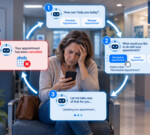
When appointments are scheduled a week or more in advance, plans can change — and busy patients forget. Sending timely reminders — one the week before, the day before, and another the day of — can help ensure appointments stay top of mind.
More importantly, appointments that are booked ahead of time may not be needed by the time the day arrives. But if patients have to call the practice and stay on hold to cancel their appointment, they might not do so.
Enabling two-way communication can help to offer a quick and easy way for patients to reschedule — for example, by simply replying to a text. This cuts costly no-shows — which can be as high as $114,800 annually for a single physiotherapy clinic, which a recent Australian study estimated — and instantly frees up slots for patients who need medical advice sooner.
Saving appointments with automatic test results
It’s common for test results to be discussed in person — which often means booking another appointment, and again having to make arrangements for time off work or for dependants.
While in-person consultations must remain the norm for abnormal results, if there’s no follow-up action, it can be preferable to send results securely to the patient directly. That immediately frees up an appointment slot, saving valuable clinical and administrative time. It also means that for patients who’ve been waiting anxiously for their test result, they can have their worries eased more quickly and get back to daily life.
Delays are inevitable — plan them into your comms strategy
Better communication can also help patients turn up at the right time.
A single late patient or a more complex consultation can create a domino effect in busy surgeries. By midday, it’s not unusual for practices to be running 30 to 60 minutes behind schedule. So, when patients arrive a few minutes early for their appointment, a routine check-up can quickly take up half their day.
For workers or students who are trying to squeeze medical appointments into their lunch breaks, these delays mean they might need to take the remainder of the day off sick or miss an important class.
Practices should explore live delay alerts that can send automated updates if doctors are running late, with a new expected appointment time. It means patients can manage their time more effectively — whether that means staying at their desk slightly longer than planned or tweaking their transport arrangements — preventing additional unnecessary stress and frustration on the patient’s side.
Putting communication upgrades into practice
Automated, two-way messaging only works when patients actually read, understand and trust the messages they receive. Because patient demographics, access to the internet, and tech literacy varies widely, healthcare providers need to have a flexible approach rather than sticking to a single channel.
Fortunately, healthcare providers have several options to choose from:
- SMS continues to be one of the most reliable channels for straightforward reminders like appointment alerts. High open rates of up to 98% mean SMS is often the best channel for critical messages that can’t be left unseen.
- For two-way conversations, WhatsApp is becoming increasingly popular due to its familiar, secure and user-friendly interface where patients can confirm or ask quick questions without having to download new apps, remember portal passwords or wait on the phone.
- Rich Communication Services (RCS) is the next evolution of SMS, and is currently being rolled out across Australia. RCS brings app-like features — like high-resolution photos, interactive buttons and verified sender profiles — directly into a patient’s messaging inbox.
Regardless of channel, trust remains vital as Australians are becoming increasingly aware of text-based scams. ACMA’s Sender ID rules, which came into force earlier this year, aim to help boost patient trust by making it harder for scammers to imitate trusted brands.
To prevent patients from getting caught out or important messages being ignored, healthcare providers should ensure messaging is consistent across every channel and that they have a verified sender ID or business profile set up correctly.
Modernising patient–provider comms for today’s demands
Australia’s healthcare system can’t fix its capacity challenges overnight, but small shifts in how practices communicate with their patients can make an immediate difference. Replacing phone queues and broken rescheduling links with trusted, two-way messaging offers relief to busy reception teams and GPs, and means Australians spend less time waiting for the help they need.
Importantly, modernising patient engagement doesn’t mean the entire system needs an overhaul. To help healthcare providers balance different channels without added complexity, Esendex has launched its new multichannel communication API suite, which allows healthcare organisations to manage SMS and soon WhatsApp and RCS through a single integration without having to move away from their existing system.
To find out more about its new API suite and limited-time SMS API offer for new customers, visit www.esendex.com.au/sms-api-offer.
When AI Wastes More Than a Patient's Time
The goal shouldn't be to create a system that simply mirrors our previous one: An AI-enabled...
The healthcare transformation challenge: delivering more care with diminishing resources
Hospital + Healthcare spoke with Tony Mahony, Head of Healthcare & Emergency...
Beyond Disconnected EDC and eCOA: How AI and Connected Clinical Technology Improve the Patient and Site Experience
The opportunity is to create a connected clinical ecosystem where data, technology, and AI work...