A new national approach to clinical governance
By Gillian Giles* and Dr Cathy Balding†
Friday, 21 August, 2026

All health ministers have urged acute health services to implement new clinical governance guidance from the Australian Commission on Safety and Quality in Health Care. The Commission’s Gillian Giles and clinical governance expert Dr Cathy Balding explain what that means for those working in Australian hospitals.
From the wards to the boardroom and executive offices, support services and corporate teams, everyone who works in a hospital can influence the quality of patient care.
While clinicians and support staff are committed to delivering the best possible care, the complexity of modern health care can make it challenging to deliver consistently high-quality care.
As in all countries, Australian hospitals are facing evolving challenges such workforce shortages, growing patient numbers and new models of care.
Patient outcomes are influenced not only by individual effort, but also by the systems, processes and organisational culture in which people work. We know from accreditation data and inquiries into safety failures that aspects of clinical governance remain difficult for many health services.
After the states and territories requested national leadership in this area, the Australian Commission on Safety and Quality in Health Care (the Commission) prioritised strong, outcome-focused clinical governance as part of national efforts to strengthen the safety and accountability of health care.
As a first step, the Commission recently released a new National Model for Clinical Governance (national model) as part of a broader program of work that aims to drive high-quality care and better outcomes for patients in Australian hospitals.
Based on the latest evidence and contemporary best practice governance as well as rigorous consultation across the health system, the national model reshapes Australia’s approach to clinical governance.
It shifts the main focus in public and private acute health services from accreditation compliance as an end in itself to part of a broader strategy for delivering consistently high-quality care.
Importantly, the national model highlights the crucial role of boards and executives in governing for high-quality care.
What does clinical governance mean?
A term originally coined by Britain’s National Health Service in the 1990s, clinical governance has not always been meaningful for the health workforce.
The Commission has created a new definition that highlights the purpose — providing high-quality care for patients:
Clinical governance is central to providing the best possible outcomes for patients. It is the combination of organisational culture, systems and structures that enables everyone in a health service to deliver care that is consistently high quality and improving.
Effective clinical governance means that boards, executives, clinical leaders and the workforce are clearly accountable to patients and the community for providing high-quality care — care that is person-centred, safe, effective, accessible and integrated, provided in a way that is equitable, efficient and sustainable.
Simply put, clinical governance enables heath service boards to govern for high-quality care.
**************************************************
Clinical governance: your health service ‘road safety system’
Think of clinical governance as being like a road system, with high-quality care as the destination.
If everyone always drove well, there would never be an accident. But safety on the roads cannot be guaranteed because the road system is complex. The road system is managed to achieve the goals of a safe and efficient journey for drivers, via a mix of factors that can be controlled and responding to those that cannot.
Accidents and other disruptions to achieving these goals occur for many reasons. Some factors — such as the weather, driver behaviour, the volume of cars on the road and human error — can be managed but not controlled. These factors must be anticipated, identified and responded to in real time. Accidents are then investigated and lessons applied to improve the way that roads function.
Factors that can be controlled include road signs, design and construction, and road rules and enforcement, all underpinned by monitoring and adjustment systems. Public campaigns guide drivers to do the right thing while speeding fines and other deterrents are an incentive to drive safely.
Health care is even more complex. On any given day, staff can only manage — not control — many factors, such as the type, number and condition of patients, response to treatment, staff shortages, emergencies, pandemics and human error.
As with the road system, boards, executives and managers must support staff to deliver high-quality care within this challenging environment. Controllable factors include equipment, work design, rules, patient flow management and skills development, all underpinned by monitoring and adjustment systems. Incidents are investigated and lessons applied to improve care. Anticipating and responding to the ‘uncontrollables’ with planning and responsiveness is also essential.
Effective clinical governance is designed and implemented to support both proactive and responsive approaches, including:
- A culture where leaders understand, plan for and implement the organisational conditions for high-quality care
- A workplace where there are enough skilled staff and that they understand their critical role in high-quality care
- A physically, psychosocially and culturally safe workplace where staff can speak up for safety and help to predict and manage the ‘uncontrollables’
- Partnerships with consumers to identify and fix care ‘potholes’, and design for high-quality care
- Rules, guidance, systems, work design and training that support consistent practice
- Systems that anticipate and minimise the impact of human error
- Deterrence from doing the wrong thing, and support for accountability without blame when errors occur
- Monitoring, feedback and learning
**************************************************
The new National Model for Clinical Governance
In developing the new national model, the Commission reviewed the latest evidence and consulted with leaders and clinicians across Australia to understand how clinical governance is understood and applied, gaps in capability and delivery, and what high-performing organisations do differently.
The result is a short, simple, principles-based document that health services can use to review and strengthen their clinical governance arrangements.
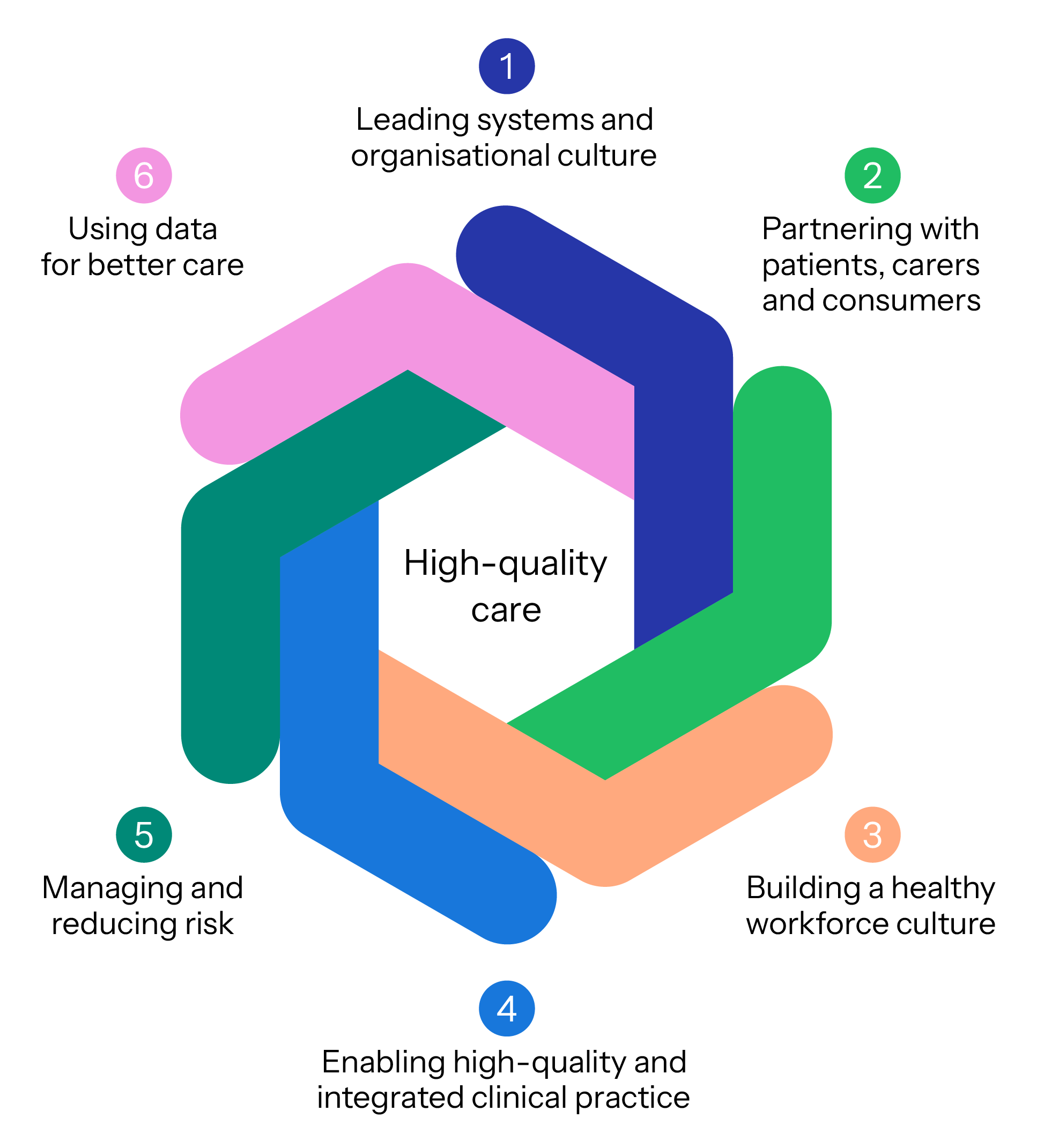
The national model describes organisational systems that support health services to deliver high-quality care, structured around six foundations of clinical governance (see Figure 1). When combined, these foundations underpin an effective organisational approach to providing consistently high-quality care.
The national model stresses that of all the foundations, leadership is a critical enabler of effective clinical governance. That is because a hospital cannot provide high-quality care at all levels of the organisation without a clear strategic direction and the necessary leadership and accountability.
It also emphasises the close link between staff satisfaction and patient outcomes and shows how provision of high-quality care depends on a healthy workforce culture in which staff feel respected, valued and safe to speak up for safety.
Each foundation includes good practice examples and warning signs to alert boards and executives to strengths and weaknesses in their clinical governance systems.
What should health services do with the model?
All health ministers have urged Australian hospitals to implement the national model as soon as possible.
Boards and executives can use the six foundations of clinical governance to check that their organisation’s strategy, systems and culture are aligned to deliver care that is consistently high-quality and improving.
The Commission has developed a practical guide to implementation that supports health services to compare their existing clinical governance arrangements against the national model, identify gaps and implement necessary changes for their own contexts.
Health services are not expected to revise their existing clinical governance frameworks immediately. But it is worth noting that the Clinical Governance Standard in the next edition of the National Safety and Quality Health Service (NSQHS) Standards will be structured around the national model’s six foundations of clinical governance. From 2030, all health services need to meet this standard to maintain their accreditation.
Effective implementation of the national model will strengthen health services’ clinical governance arrangements and position them to better address the requirements of the NSQHS Standards.
What will the changes mean for the workforce?
We know from our consultation that there is a tendency for some members of the hospital workforce to think of clinical governance as something the safety and quality manager does — a series of forms and boxes to be ticked for accreditation.
We hope the national model will change that. It stresses that everyone in a health service needs to be involved in working with and improving clinical governance systems, because providing high-quality care should be everyone’s focus (see Figure 2).
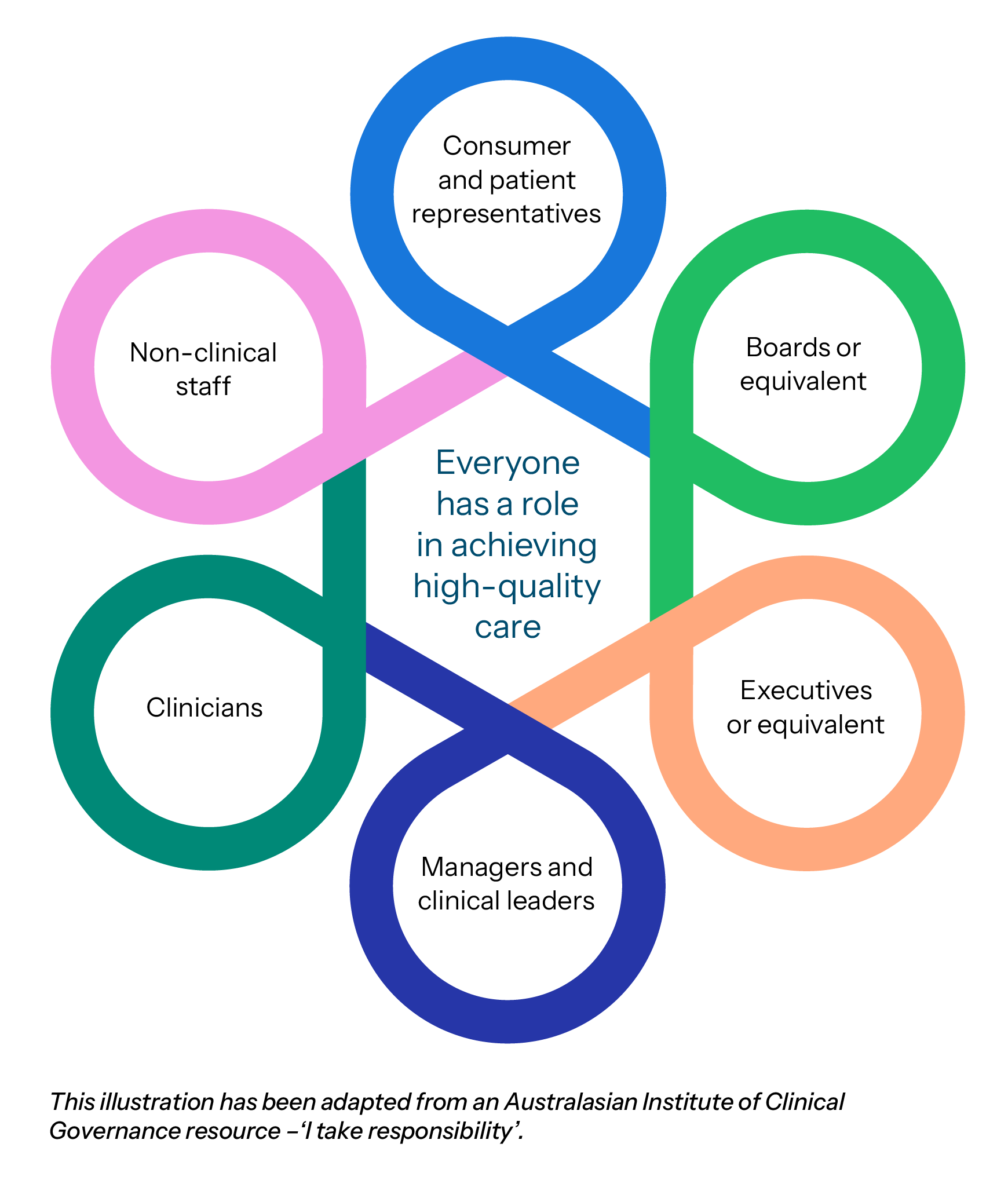
A key message is that clinical governance is not an end in itself. It is not something that needs to be ‘done’ because the Commission has released a new model, or because accreditation requires it.
Implementing the national model as intended will help health services to operate with renewed purpose. The workforce will be more supported and feel more appreciated; they will know their organisation backs them with the right culture, structures, support and leadership to provide consistently high-quality care, and patients will receive the care they need and expect.


Top 4 lessons from an ICAC NSW Health employee investigation
The NSW corruption watchdog said this investigation highlights recruitment, procurement,...
Tapping into the labour mobility market to fill ongoing workforce gaps
Health and aged care is under pressure to deliver high-quality care with short-staffed teams....
Australian health care's burnout prescription
Claire de Carteret, Managing Director, APAC at Gallup, sets out how effective, supportive...