Mindfulness and endoscopies — a more effective combination?
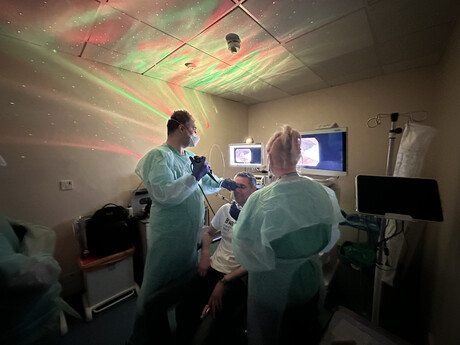
Mindfulness, combined with advanced endoscopy techniques and state-of-the-art digital technology, could enable procedures to be done to a higher standard in awake patients than is currently possible under general anaesthesia or sedation. This is according to British researchers, who say the approach also means there is less chance of cancers being missed, with fewer associated complications, and less cost.
This follows a ‘mindful endoscopies’ study in the UK (published open access in British Journal of Nursing, doi: 10.12968/bjon.2025.005), where of the 231 patients who had endoscopies with the team, 92% were satisfied or very satisfied with their experience. Further, patients whose endoscopies were supported by mindfulness were found to have higher satisfaction levels than had previously been reported by patients who’d been sedated.
Faster route to treatment and challenges of existing approaches
Another advantage, according to the researchers, is a faster route to treatment, with the potential of reducing waiting lists by moving some procedures out of operating theatres and sedation facilities and into outpatient clinics and community diagnostic centres. As the researchers argue, ear, nose and throat (ENT) surgeons often perform partial examinations of the mouth, throat and voice box in outpatient clinics without sedation.
Full examinations, however, are not typically available in outpatient clinics as they provoke strong coughing and gagging responses. But now, the researchers say, they have made it possible to fully examine the mouth, throat and voicebox in awake patients, and when necessary, the oesophagus and the stomach, too — using mindfulness.
“A patient with a hoarse voice, throat problem or difficulty swallowing can walk into the clinic, have a more thorough examination in less than 10 minutes than is possible in many cases under general anaesthesia, and walk out reassured,” said Professor Reza Nouraei, Professor of Laryngology and Clinical Informatics at the University of Southampton.
Nouraei — who is also a consultant ENT Surgeon at the Loxley Centre for Airway, Voice and Swallowing at Queen’s Medical Centre, Nottingham — added: “This one-stop approach means that most problems can be diagnosed with one appointment.
“For the small number of patients with cancer or other major problems, biopsies can often be taken there and then, and the road to treatment and recovery can begin straightaway,” Nouraei said. “Using mindfulness to support patients through these examinations is a large part of what makes them possible.”
It’s not usually possible to fully examine the complex structures of the mouth, throat and voicebox in awake patients, the researchers said. This is due to gag and cough reflexes, which make general anaesthesia necessary for a complete assessment, with only high-risk patients typically undergoing such exams, because of the risks and costs of general anaesthesia.
However, while this approach avoids unnecessary procedures, it can miss early cancers hidden in folded areas of the throat, especially in patients without obvious symptoms. This can lead to delayed diagnosis and treatment. This is why researchers from the University of Southampton and Nottingham University Hospitals NHS Trust designed this study.
The Mindful Endoscopy team — their method and results
Wanting to see if mindfulness could enable complete endoscopies to be routinely carried out in outpatient clinics, the researchers created a Mindful Endoscopy team at Queen’s Medical Centre in Nottingham. The team would guide patients through the procedure using a range of mindfulness practices involving breathing, relaxation, communication techniques and positive imagery.
“These mindfulness techniques give the patient a sense of control in what could otherwise be a disempowering situation, which helps to regulate emotions and reduces the mental space available to catastrophising thoughts,” Nouraei said. “Mindfulness also has a range of very specific effects that create a sense of calm at a physiological level.
“These range from lowering the heart rate and blood pressure, through to dissipating coughing and gagging before they can take hold and cause discomfort.” Through the study, mindful endoscopies revealed 12 cancer diagnoses — 5%, which is a typical cancer diagnosis rate. At an average of 12 months after the endoscopy, no cancers had been missed.
The 92% ‘satisfied or very satisfied’ with their experience rating of the 231 patients who had endoscopies with the team compares favourably with findings from a 2019 study that found a 53% satisfaction rate for patients who’d had conventional aerodigestive endoscopies while awake, and an 86% satisfaction rate for patients who’d been sedated.
The potential of perioperative mindfulness
In the UK context, the researchers point out that improving examinations to help detect cancers earlier is especially important given the 2024 NHS investigation findings that, aside from lung cancer, the NHS has made little progress in early cancer detection. The researchers believe that mindful endoscopy could also be readily delivered in community diagnostic centres, thus moving diagnostic care closer to home.
“This study demonstrates just one way in which mindfulness can be incorporated into a procedure to improve patients’ experience and use NHS resources more effectively,” Nouraei said. “For the past 18 months in Nottingham, we have been using perioperative mindfulness to offer interventions to up to 22 patients with airway and voice problems in a single operating list.
“Before, when the same procedures used to need general anaesthesia, we could only operate on six to seven patients per day,” Nouraei added. “We believe perioperative mindfulness could not only make a decisive difference in early cancer detection but also free up operating theatres and reduce waiting lists for many other procedures. We hope that this approach could be applied in different clinical settings, and across different procedures.”
"Hell in a handbasin": infection considerations of four handbasin design features
An Australian-led review has compared healthcare handbasin design guidelines across 39 countries...
Could this eco-friendly antimicrobial coating curb healthcare-associated infections?
The coating, made from Queensland agricultural waste, is part of a two-year trial in the ICU of...
Preserving paediatric data beyond the point of care
A clinician-led, research-driven program for the care of babies and children seeks to securely...