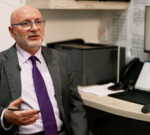
Telehealth research gets a $2.5m boost
Tuesday, 20 August, 2013
Healthcare will soon be more accessible for more Australians with the announcement of a $2.5 million Federal Government grant to The University of Queensland to advance telehealth research.
The National Health and Medical Research Council (NHMRC) awarded the funds to UQ's Centre of Research Excellence (CRE) in Telehealth led by Professor Len Gray, Director of the UQ Centre for Online Health.
Professor Gray said the CRE in Telehealth brought together an internationally recognised team from four telehealth research groups at UQ: The Centre for Online Health, the Centre for Research in Geriatric Medicine, the Telerehabilitation Research Unit, and the Dermatology Research Centre.
“It is supported by technical experts in health economics, information technology, engineering, health informatics, workforce planning and management,” he said.
Professor Gray said the centre aimed to accelerate telehealth research into healthcare delivery and increase the cohort of telehealth researchers and practitioners.
“The CRE in Telehealth will focus on health service settings where access is currently challenging, such as small rural hospitals, residential aged care facilities, people's homes (particularly for disabled and older people), and indigenous communities,” Professor Gray said. “The telehealth team has extensive research and translation experience in telemedicine in paediatrics, geriatrics, speech pathology, physiotherapy and dermatology. “We have partnered with experts from the UQ School of Business, the Inala Indigenous Health Service and the Griffith Health Institute at Griffith University to ensure the highest quality research to address the major challenges facing telehealth expansion.”
UQ President and Vice-Chancellor Professor Peter Høj congratulated the UQ researchers and their collaborators on securing the grant, which will have lasting impact through a better understanding of the benefits of telehealth.
“It's an opportunity that UQ relishes, because the potential beneficiaries are not only the people of non-metropolitan Australia, but also people living in our cities and suburbs.”
Better questions, clearer choices: putting the person at the centre of continence support
Better continence support begins before a product is chosen. It begins with better questions,...
A Day in the Life of a rural generalist anaesthetist and men's mental health advocate
Dr Hayden Cain is a rural generalist anaesthetist who has a particular interest in men's...
Rapid-response discharge model targets bed block
As health ministers call for urgent federal action on bed block, this NSW home and community care...